Bài đăng

Đang hiển thị bài đăng từ Tháng 4, 2023

New interview on Scholarly Communication podcast

Hình ảnh
I’m fortunate enough to be on the Scholarly Communication podcast with Daniel Shea! (I think it’s episode 91, but they don’t number them by default.) While the ostensible reason I was on was to talk about the Better Posters book, the conversation ranged widely. Daniel and I talk about narrative, collaboration, and efficiency in the realm of academic communication more generally. Here are a couple of posts I mention during the interview. First, this is the post where I talk about my wariness anyone says, “ We need to do a better job training Ph.Ds in... ”. Second, this is the post where I talk about how my writing class completely, totally, 💯 rejected the idea that storytelling has any place in science. So storytelling is dead, long live narrative . You can listen at the New Book Networks website or probably any other place you get your podcasts (like Stitcher ). External links Scholarly Communication podcast home Scholarly Communication: Better Posters https://sco.lt/7pJxjs | h...
RIP Robin Overstreet

I learned yesterday that Dr. Robin Overstreet died. Dr. Overstreet played a small but important part in my research. When I realized that things I was seeing in shrimp nerve cords were not staining artifacts but were alive, my colleague Brian Fredensborg contacted Dr. Overstreet. Robin generously keyed them out to the genus at least. Polypocephalus , a larval tapeworm. I think the three papers I co-authored about that animal would have been much harder to sell to editors, reviewers, and readers, if we’d had to write something like, “Unidentified parasite A.” I met Overstreet at a American Society for Parasitology meeting in San Antonio in 2017 in front of my poster. I was glad I was able to thank him for helping me, my student, and colleague. We talked a little about potential for more collaboration, but alas, it wasn’t to be. https://diigo.com/0ov0t2 | https://diigo.com/0ov0t5 | https://twitter.com/surveytrue_/status/1519623691100770304 | https://twitter.com/surveytrue_/status/1...

The big two oh blogiversary

Hình ảnh
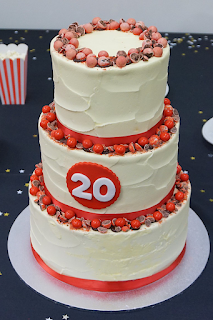
Happy blogiversary to me! Twenty (!) years ago, I started blogging for the first time, right here on this blog. I can’t even remember the first title, though it certainly wasn’t NeuroDojo.  Blogging became a habit. Besides this blog, I still maintain two other blogs that are updated regularly, Marmorkrebs and Better Posters . And while many once active blogs have slowed down – including my own – I would never consider shutting down all my blogs. It has been far too rewarding. (I mean, I finally got to write a book because of blogging!) For this blog, NeuroDojo, I have been proud of the times little things broke out of the blog and impacted other arenas. I am pleased that a horrible, sexist paper originally published on paper and retracted finally got a retraction notice slapped on its online version. I’m pleased that a journal worked on guidelines for presenting statistics because of something I wrote. The word “kiloauthors” took on a little life of its own. And I want to say th...

New podcast epiode for ABT Time

Hình ảnh
My newest podcast interview is the ABT Time podcast, episode 39, hosted by Randy Olson . Randy has featured on the blog a few times before, so long time readers may recognize that “ABT” in ABT Time is an abbreviation for “ And, but, therefore ” – the key words for making a concise narrative. The ABT structure features prominently in the Better Posters book because it is an powerful tool for encapsulating a project in a sentence.  The podcast mostly talks about narrative and posters, but because I’ve crossed paths with Randy a few times, our chat is more conversational than formal interview. The ABT Time podcast should be available wherever you get your podcasts (Apple, Spotify, YouTube, etc.). External Links ABT Time #39 on ABT Agenda https://diigo.com/0s6qjc | https://sco.lt/5r0DvE | https://maxelectricvn.wordpress.com/2023/04/04/nam-loi-khuyen-de-bao-tri-tu-dien/ | https://telegra.ph/%C6%AFu-%C4%91i%E1%BB%83m-c%E1%BB%A7a-vi%E1%BB%87c-l%E1%BA%AFp-%C4%91%E1%BA%B7t-t%E1%BB%...

End abstract sponsorship for the Neuroscience meeting

Hình ảnh
Tomorrow is the deadline to submit abstracts for the Neuroscience meeting (the biggest academic meeting in the world ). This meeting does something that I have never seen at any other meeting. Every presentation and poster needs a society member to “ sponsor ” the abstract. And a member can only sponsor one scientific and one “metascience” presentation. “So just become a member.” Not that easy, because membership also requires you to be sponsored by two active existing members. So if you are in a smaller campus, there may be no existing member who can sponsor you. If you are in a lab with three society members but want to present four posters, you’re stuck. The problem is so obvious that the Society’s Twitter account has taken to trying to help people rustle up a member to sponsor abstracts by retweeting requests. Like this . Desperate last minute request from a @UniLeiden postdoc! Would anybody mind sharing their @SfNtweets membership ID for me to be able to use as a sponsor? Mu...

Prediction: American creationists will try again to get evolution out of schools

On Friday, the United States Supreme Court repealed Roe v. Wade, which was precedent for the nation-wide legal right to an abortion. That sucks.  I won’t pretend for an instant that I have anything particularly insightful to say about that particular case. But I do want to post something here about something this signals that are relevant to my own particular interests, namely science education. It is clear that the US Supreme Court repealed Roe v. Wade because they could . Far right conservatives have been wanting this and threatening this for years. It was always clear that as soon as there was conservative majority on the court, Roe v. Wade would be under threat. And now it’s done. There was not a reasoned legal decision. This was a partisan power play to give far right conservatives what they wanted. There is every reason to think that far right conservatives are going send a host of cases going to the Supreme Court. Andy Kim reported hearing, “Let’s keep this going now” on th...

Is using AI to write a paper academic misconduct?

Hình ảnh
We’ve come a long way from ELIZA . Or the ridiculous duelling chatbots. Natural language artificial intelligence has recently gotten far better than I think many people realize, and today’s article in Scientific American points that out. A researcher asked an open source artificial intelligence program, GPT-3, to write an academic paper. It did such a good job that the preprint is out and the paper is now under review at a technical journal. Publicity stunt? It smells a little like that, but then again, this is an area that needs some publicity. As natural language program like  GPT-3 get more widely available and more widely known, of course university students are going to do what these researchers did. They are going to get the programs to write their papers. How is that going to shape up in our thinking about teaching? It using an artificial intelligence to write a term paper cheating? I suspect a lot of my colleagues would say, “Yes,” for the same reason that asking an actual...

An Immense World reviewed

Hình ảnh
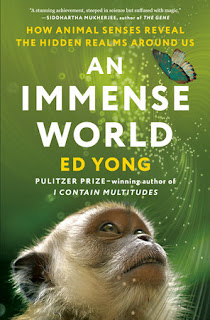
Dear Mr. Yong, I wish to make a complaint . Your book, An Immense World , covers ground with which I am well familiar. I teach the concept of Umwelt – the “sensory world” of animals – frequently in my university classes, and have made my own modest contributions to the field of sensory biology. That confession might lead you to think that my complaint is that I was not among one of the many researchers interviewed for your work, as you have clearly done substantial and thorough investigation of the material presented in this volume. Indeed, the interviews sprinkled liberally throughout the book are informative and often delightful. I assure you, sire, I have a clear-eyed understanding of my stature in the scientific community and I am not so vain as to think my trifling work on crustacean nociception warranted inclusion in this volume. Indeed, this book is so close to my interests in teaching that one might suspect that my complaint is that I wished to write this book. But this is not...

A star chamber for predatory journals

Hình ảnh
Look, I am not one for conspiracy theories.  But if I was a major academic publisher, and I saw a lot of business going to new, upstart publishers that had even slightly questionable editorial practices, I’m not sure I would back a way from a little aggressive corporate public relations. I might set up a website that claimed to be providing a service by listing dodgy journals and publishers, and then – Bam! 💥 – I label a bunch of stuff coming from the competition as “predatory.” Meanwhile, today I learned about a website called Predatory Reports in Scientific Publishing . I noticed today because they recently stuck a bunch of MDPI journals on their blacklist . Their Twitter account has been around for a little over a year. It’s interesting that I never heard of them before they target MDPI, which fits the narrative of people who are already grumpy (legitimately so) with MDPI. Looking around their website, I clicked the “About” page, I thought this was an overly honest image: An em...

The Last Days of the Dinosaurs reviewed

Bản tóm tắt này không có sẵn. Vui lòng nhấp vào đây để xem bài đăng.

Lessons from megapodes: You can waste a lot of time trying to save time

Hình ảnh
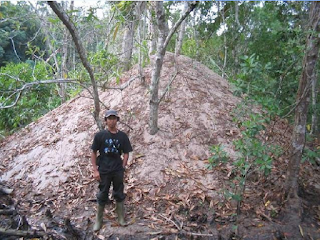
In his book Last Chance to See (co-authored with Mark Carwadine), Douglas Adams describes nesting by megapode birds. Megapodes don’t build a typical next out of sticks and feathers and mud and the like. Instead, they build these enormous mounds, stacked with decaying vegetable matter.  Compost, basically. As the compost decays, it generates enough heat to incubate the megapode’s eggs. In his often imitated but never equalled style, Adams wrote: So all the megapode has to do to incubate its eggs is to dig three cubic yards of earth out of the ground, fill it with three cubic yards of rotting vegetation, collect a further six cubic yards of vegetation, build it into a mound, and then continually monitor the heat it is producing and run about adding bits or taking bits away. And thus it saves itself all the bother of sitting on its eggs from time to time. Put like that, it doesn’t seem like that much of a time saver. To get those numbers of megapode nest size to put into his book, Ad...

What happened to Matters?

Hình ảnh
A few years ago, a journal launched called Matters . The interesting thing about this journal was that it was devoted to single observations. Science magazine saw fit to write about Matters , so it’s not like it was hidden in a dark hole under the stairs somewhere. The journal homepage is now offline. The journal’s Twitter account hasn’t sent tweeted since 2019. The person behind the journal, Lawrence Rajendran , is still active on Twitter, however. Worst of all, I can’t find articles published in Matters using the DOI. They seem to have completely vanished into the ether. (There was a cool one about hermit crabs.) I’d noticed that Matters vanished a while ago, but couldn’t tell you when. But I was reminded because I learned of MicroPublication Biology . It seems to be trying the exact same thing Matters did: offer per reviewed publication for single short papers that don’t fit into some larger narrative. I’m skeptical of MicroPublication Biology because nobody’s name appears anyw...